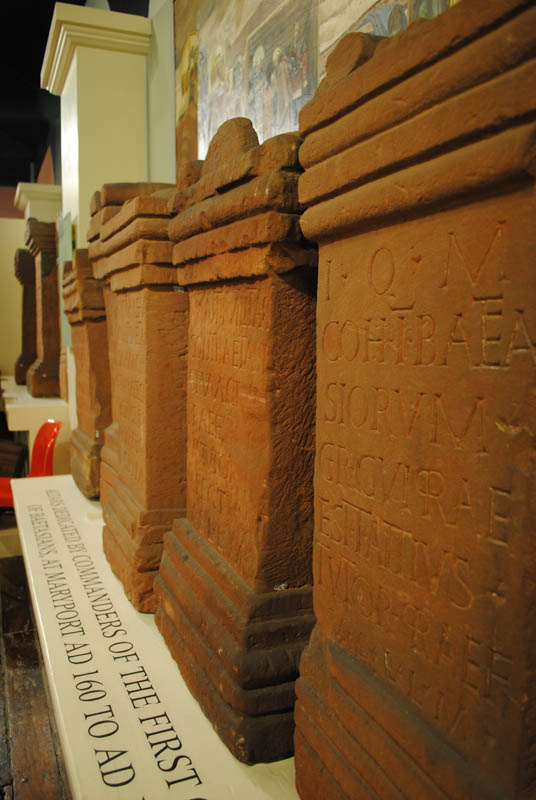
 Exhibits from Senhouse Museum.
It may have been a disadvantage that for the second year running the circumstances of our speakers meant we had only one lecture before Christmas. (We also had to drop the planned lecture on Ovid because none of our preferred speakers could help us this year.) In the Autumn we opened with a reading of Libation Bearers/Choephori in translation at our Chairman's house, following which a group of members travelled together to see the Oxford Greek Play performance. This was followed by a lecture at Wolstanton) by Trevor Fear (Open) on Seneca's De Beneficiis.
In January we had a play reading of Sophocles' Ajax at The Leopard, Burslem, leading up to a return visit by Patrick Finglass (Nottingham) to speak on the play, at Keele (Hellenic Society joint meeting.) The next meeting was a prose reading, as pioneered in 2011, of Cicero's Pro Caelio, in two parts, a month apart. This preceded Jonathan Powell's lecture on the speech, and Cicero as an Advocate, at Keele. This was the Roman Society joint meeting. We are grateful to Keele SCR for free use of the room for these meetings.
Our last lecture, in May, was by Jason Konig (St Andrew's) on the Ancient Olympics, especially in the Roman period. This was at Clayton Hall Business & Language College, to which we are again grateful. It is possible however that members do not want lectures on Summer evenings. Our annual coach trip, the preceding weekend in May, was as usual open to other bodies and was to Roman Cumbria, including Brougham Castle within the ramparts of a Roman Fort, and Senhouse Roman Museum, Maryport. We are grateful as ever to Andy Fear for leading us round both sites.
The Latin and Greek reading groups have continued to run very successfully, approximately monthly throughout the year, independently of the core programme.
Copies will be available, but please bring the Penguin Classics edition, if you are able
Copies will be available, but please bring the Penguin Classics edition, if you are able.
Copies will be available of the translation in the Penguin Classics edition (Political Speeches of Cicero)
As usual we will depart by coach from Keele, about 8.30 a.m., returning late the same evening. On our outward journey, we shall visit the English Heritage site at Brougham Castle, near Penrith, which was built within the walls of the Roman fort of Brocavum. Admission is free for English and Scottish Heritage and Cadw members, so please bring cards if you have them. We will seek to raise enough money to pay for group admission for the rest, but this will depend on numbers, and we will decide on the day. Members are invited to bring packed lunches to eat at the castle site before proceeding to Senhouse Roman Museum, Maryport, on the Cumbrian coast. There is an extensive collection to see there, including many altar dedications.
The Museum is run by an independent trust, so again group admission will be obtained, if possible included in the advance cost of the day. There will as usual be a halt for more leisurely evening dining on the road home, at the Longland Hotel, Tewitfield, near Carnforth, where we halted on our return from our last Hadrian’s Wall visit. Those booking will be asked to choose from a menu either in the morning or in advance of the trip.
Exhibits from Senhouse Museum.
Final details of costs will be given with confirmed bookings, but these are expected to be about £25, exclusive of evening meal, depending on final costs of group entry. Further details will appear on this site before the trip. The booking form may be downloaded here.
This talk looks at the history of the ancient Olympic games, which ran for more than 1000 years, from 776 BC to roughly AD 400. It focuses especially on some of the ancient documents which bring the experience of ancient athletes and spectators to life, gives special attention to Greek athletics in the Roman Empire (first to third centuries AD), when the Olympics were at their peak. Nearly every Greek city in that period had its own athletic festival, in many cases more than one, and prominent athletes were international stars, travelling far and wide across the Mediterranean world in pursuit of successive victories. It also looks as the connections between ancient athletics and the modern Olympic tradition, covering the use of classical tradition in the 1896 games in Athens and the 1936 games in Berlin, and more broadly at some of the similarities and differences between ancient and modern sport.
Last year's programme and Annual Report
 Back to Home Page